PROJECT
Nextdoor's AI Marketplace Listings
ROLE
Lead Designer
PROJECT
Nextdoor's AI Marketplace Listings
ROLE
Lead Designer
SUMMARY
A smart feature that boosts marketplace listing completion by instantly generating suggestions from just one photo.


CHALLENGE
Creating a marketplace listing is often a high-friction, multi-step process that requires time, effort, and decision-making—leading to drop-off, delayed posting, or full abandonment. The opportunity was to rethink listing creation from the ground up by reducing cognitive load and enabling users to move from intent to published listing as quickly and effortlessly as possible.
PROJECT GOALS
Our goal was to increase marketplace supply by fundamentally simplifying how listings are created on Nextdoor. We introduced a photo-first, AI-powered approach that auto-generates key listing details—reducing manual input and accelerating time to publish.
By lowering both effort and friction, we aimed to improve key supply-side metrics, including:
- listing creation rate
- listing completion rate
- listings per active seller
DISCOVERY & RESEARCH PHASE
As the lead designer, I partnered with engineering to explore how OpenAI could power a scalable, cost-efficient solution. With ~33K listings created daily, cost was a key constraint. We selected a lower-cost model and validated through testing that reduced image detail still produced accurate results. I also worked with our data scientist to identify key drop-off points in the listing flow, helping prioritize where reducing friction would have the greatest impact.
To balance quality and cost, we iterated on prompt structure and scaled images before submission—reducing processing costs without sacrificing output accuracy.
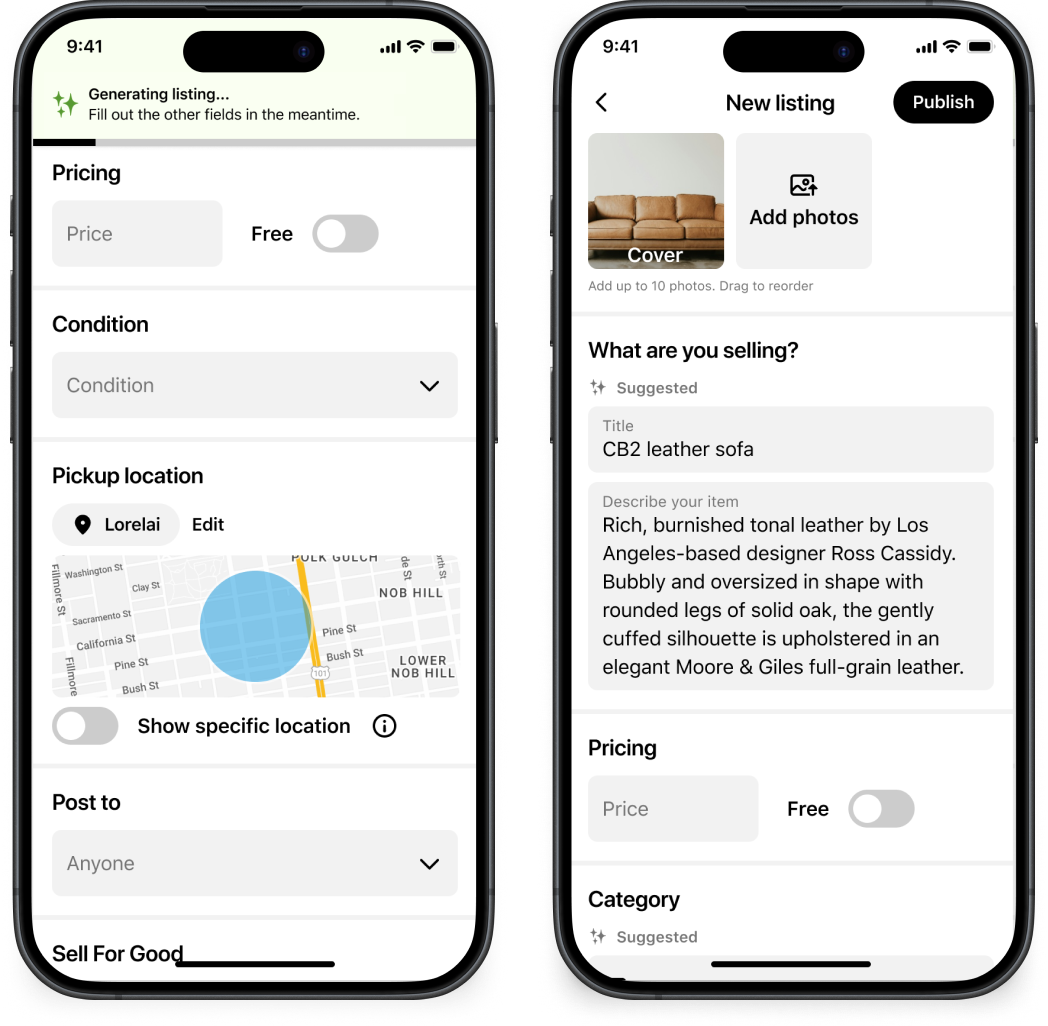
LOAD TIME/ TIME TO MEANINGFUL RESPONSE (TTMR)
Load time was a critical factor in shaping the user experience. Since the speed of generating suggestions could vary, we explored multiple versions of the flow to account for both quick and delayed responses.
We found that in most scenarios, load time was less than a second. In the edge-case of longer-load scenarios, we designed the flow so that sellers could continue adding details to their listing while suggestions were being generated - keeping them engaged and reducing perceived wait time.
ANALYZING IMAGES
To balance cost efficiency with a smooth user experience, sellers can upload multiple photos at once, but only the first photo is processed through OpenAI to generate suggestions. Once suggestions are created, sellers can then upload additional photos to complete their listing.
VIDEO DETAIL
We optimized the video player to maximize the video space while encouraging engagement with the video. We included a swipe to show additional information. Users can send gifts to show love and participate in the conversation with other fans and artists. Because there is so much unique content in the platform, we included a description and additional tags for eaze of search.
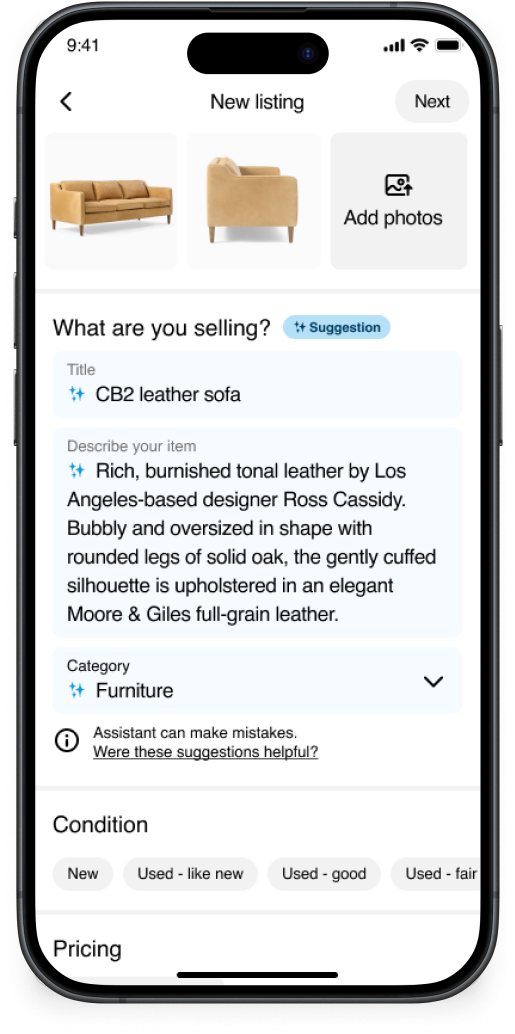
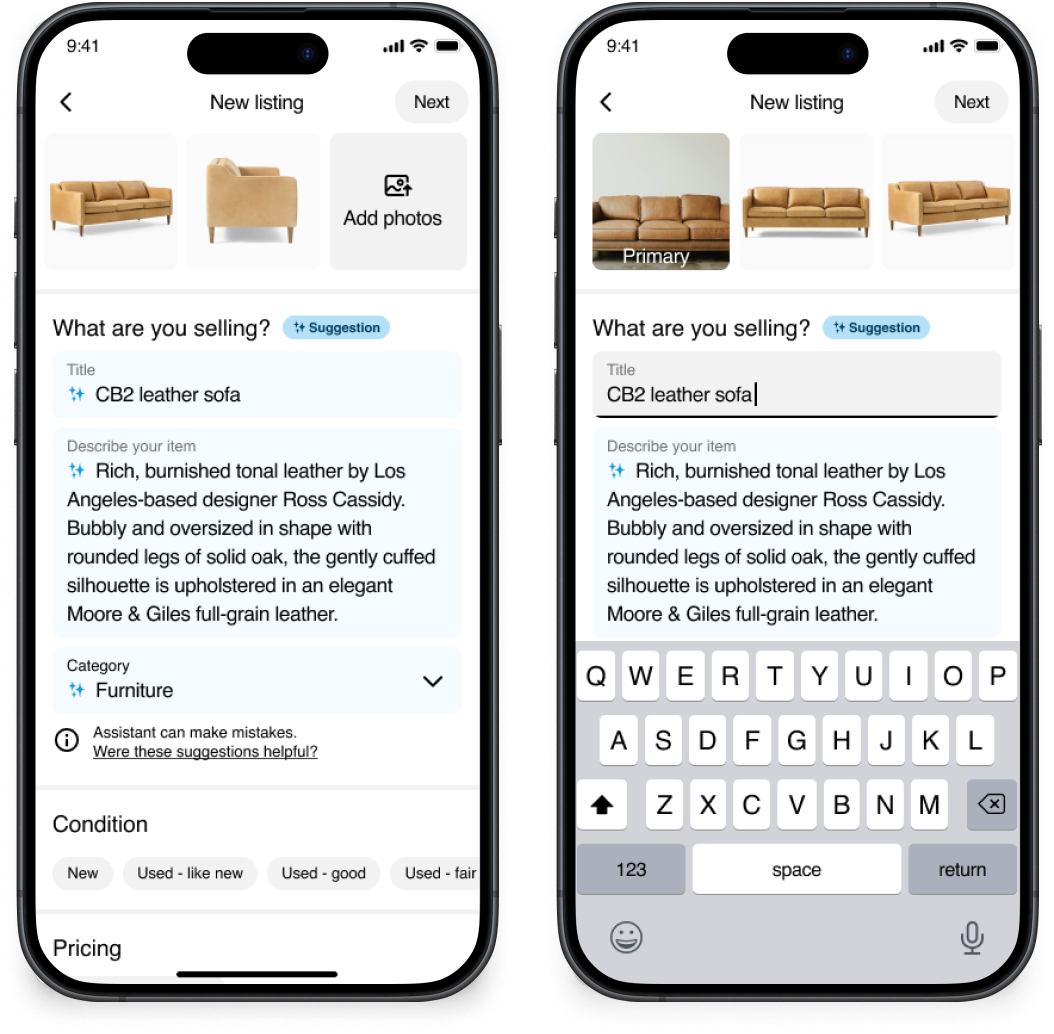
SUGGESTIONS
After a photo is analyzed, key listing fields are pre-filled with AI-generated suggestions. To distinguish them from user-entered fields, suggestions appear with a blue background and an AI icon. If a seller edits a suggestion, the field reverts to the default gray style.
FEEDBACK
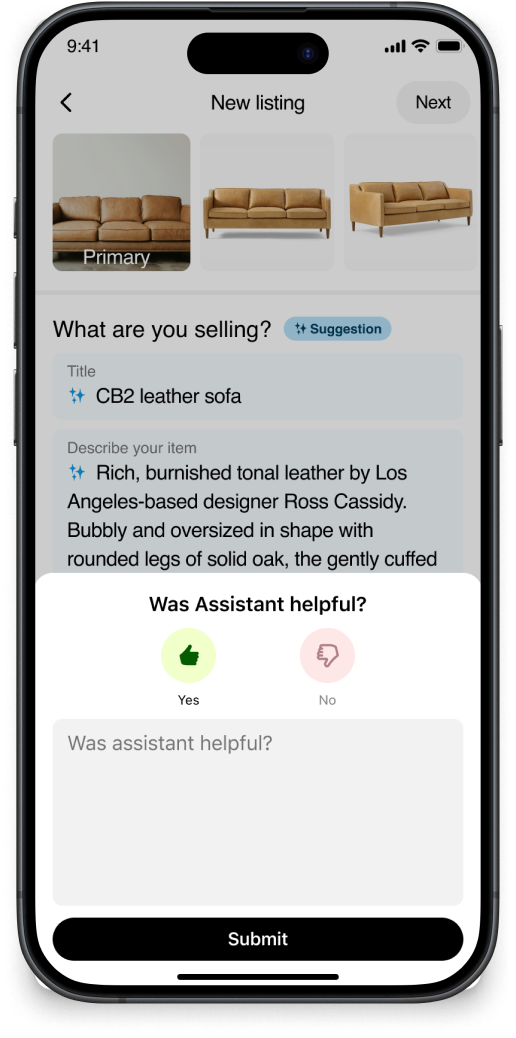
To continuously improve this feature, we built a simple feedback mechanism directly into the modal. After interacting with the suggestions, sellers are prompted to share whether the feature was helpful. This lightweight check-in not only helps us validate the value of the experience but also provides insight into how we can refine it further.
FINAL THOUGHTS
Users today often sell across multiple platforms and have come to expect a fast, seamless listing experience. By generating suggestions for all required fields from just one photo, we significantly reduce friction in the process. In most cases, sellers only need to upload an image and confirm the suggestions—saving time and effort.
Leveraging AI to generate listings not only modernizes the experience but also aligns with growing user expectations as other platforms begin experimenting with generative AI. Offering this capability to all consumers provides Nextdoor with a unique competitive advantage, since most marketplaces don’t yet support full AI-powered listing generation. (For example, Amazon provides a similar feature, but only for business sellers.)
NOTABLE MOMENTS
Nextdoor's Expanded AI Wants to Help You Sell Your Stuff Before Moving
August 12, 2024
MORE PROJECTS